



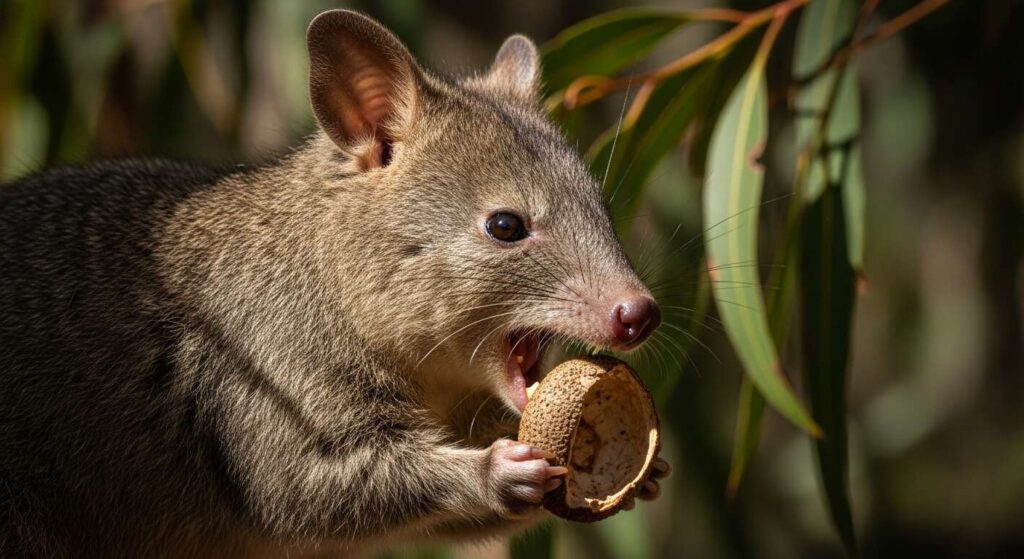
Australian ecosystems harbour remarkable creatures whose abilities often surpass human imagination. Among these, bettongs stand out as small marsupials with an extraordinary talent: they can crack open seeds so hard that attempting the same feat would shatter the jaws of most other animals. These rabbit-sized mammals have evolved specific adaptations that allow them to access food sources completely unavailable to their competitors, making them both biological marvels and essential contributors to their native habitats.
The incredible capabilities of bettongs
Exceptional seed-cracking prowess
Bettongs possess a remarkable ability to process extraordinarily hard seeds that would prove impossible for most mammals to consume. Research published in the Zoological Journal of the Linnean Society has revealed that these small marsupials can crack open seeds from sandalwood trees and native peach trees, known scientifically as quandong, which feature some of the hardest seed casings found in Australian flora.
The force required to break these seeds is substantial, yet bettongs accomplish this task routinely as part of their dietary habits. This capability sets them apart from other herbivores and omnivores in their ecosystem, granting them access to nutritional resources that remain locked away from competitors.
Dietary versatility beyond hard seeds
Despite their specialisation in cracking hard seeds, bettongs maintain a diverse diet that includes:
- Underground tubers and roots
- Various fungi species
- Softer plant materials
- Insects and other invertebrates
This dietary flexibility demonstrates that their seed-cracking adaptations have not limited their feeding options but rather expanded their ecological niche beyond what would be available to less specialised species.
Understanding these capabilities provides essential context for examining the anatomical features that make such feats possible.
The unique characteristics of their jaw
Species-specific adaptations
Studies conducted by researchers at Flinders University have identified two distinct morphological strategies employed by different bettong species. The brush-tailed bettong exhibits reinforced cranial structures that provide additional support during the chewing process, whilst the burrowing bettong has evolved a shorter facial structure that enables it to generate greater bite force.
These adaptations represent different evolutionary solutions to the same challenge, demonstrating the remarkable plasticity of mammalian evolution in response to dietary pressures.
Biomechanical advantages
| Species | Adaptation type | Primary advantage |
|---|---|---|
| Brush-tailed bettong | Reinforced skull | Enhanced structural support |
| Burrowing bettong | Shortened face | Increased bite force |
The jaw muscles of bettongs attach to these specialised bone structures in ways that maximise force generation whilst minimising the risk of injury. This biomechanical efficiency allows them to apply tremendous pressure to seed casings without damaging their own skeletal structures.
These jaw adaptations become particularly significant when considering the specific challenges posed by their preferred food sources.
Seeds as the ultimate challenge
The hardness of Australian seeds
Australian native seeds, particularly those from sandalwood and quandong trees, rank amongst the hardest biological materials found in plant reproduction. These seeds have evolved thick, resistant casings as protection against predation and harsh environmental conditions, creating a formidable barrier that excludes most potential seed predators.
The protective layers of these seeds can withstand significant impact forces and resist decomposition for extended periods. This durability ensures seed survival but also means that very few animals possess the necessary adaptations to breach these defences.
Nutritional rewards within
The effort required to crack these seeds is offset by substantial nutritional benefits:
- High concentrations of oils and fats
- Essential proteins and amino acids
- Minerals unavailable in softer plant materials
- Energy-dense nutrients supporting metabolic needs
For bettongs, the ability to access these nutrient-rich kernels provides a competitive advantage, particularly during periods when other food sources become scarce.
The skeletal modifications that enable this feeding behaviour extend beyond the jaw itself.
Cranial adaptations in bettongs
Skull reinforcement mechanisms
The brush-tailed bettong’s cranial reinforcement involves thickened bone structures in specific regions of the skull that experience the greatest stress during seed-cracking activities. These reinforcements distribute forces more evenly across the skull, preventing fractures and reducing the risk of dental damage.
This adaptation represents a sophisticated evolutionary response to the mechanical demands of their specialised diet, demonstrating how natural selection can modify skeletal architecture to accommodate specific behavioural needs.
Facial structure modifications
The burrowing bettong’s shortened facial structure creates a different mechanical advantage. By reducing the distance between the jaw joint and the teeth, this species achieves greater leverage when biting, similar to how shorter wrenches provide more torque than longer ones.
These cranial modifications work in concert with muscular adaptations, creating an integrated system optimised for applying and withstanding extreme forces during feeding.
Beyond their individual survival, these adaptations contribute significantly to broader ecosystem functions.
Ecological importance of bettongs
Ecosystem engineering activities
Bettongs function as ecosystem engineers, species whose activities substantially modify their environment in ways that benefit other organisms. Their digging behaviour, undertaken whilst foraging for underground foods, produces multiple ecological benefits:
- Soil aeration improving oxygen availability for plant roots
- Enhanced water infiltration reducing surface runoff
- Mixing of soil layers redistributing nutrients
- Creation of microhabitats for invertebrates
These activities contribute to overall ecosystem health and productivity, making bettongs keystone species despite their relatively small size.
Seed dispersal contributions
Whilst bettongs consume many seeds, they also inadvertently disperse others through their foraging activities. Seeds that survive passage through their digestive systems or are cached and forgotten can germinate in new locations, contributing to plant population dynamics and genetic diversity.
Conservation challenges
Bettong populations have declined significantly due to:
- Predation by introduced species such as foxes and cats
- Habitat loss from agricultural expansion
- Competition with introduced herbivores
- Climate change affecting food availability
Conservation efforts now focus on understanding their specific habitat requirements to identify suitable reintroduction sites and protect remaining populations.
Examining how bettongs compare to other seed-eating animals highlights the uniqueness of their adaptations.
Comparison with other animals
Relative bite force capabilities
| Animal group | Hard seed consumption | Primary limitation |
|---|---|---|
| Most rodents | Moderate hardness only | Insufficient bite force |
| Small birds | Limited to softer seeds | Beak structure constraints |
| Bettongs | Extremely hard seeds | None for target seeds |
Whilst some parrots possess powerful beaks capable of cracking hard nuts, their approach differs fundamentally from the bettong method. Birds use their beaks as tools, applying force through a different biomechanical system, whereas bettongs rely on mammalian jaw mechanics optimised through evolutionary refinement.
Evolutionary distinctiveness
The adaptations seen in bettongs represent a unique evolutionary pathway within marsupials. No other Australian marsupial has developed comparable seed-cracking capabilities, making bettongs irreplaceable components of their ecosystems.
Research continues to reveal new insights into how these adaptations developed and how understanding them can inform conservation strategies for these threatened species.
The remarkable abilities of bettongs to crack seeds that would damage other animals demonstrate evolution’s capacity to produce highly specialised solutions to ecological challenges. Their unique jaw structures and cranial adaptations enable access to food resources unavailable to competitors, whilst their ecosystem engineering activities benefit entire biological communities. Conservation efforts informed by understanding these morphological adaptations and dietary requirements offer hope for protecting these threatened marsupials and preserving their irreplaceable ecological roles in Australian landscapes.