



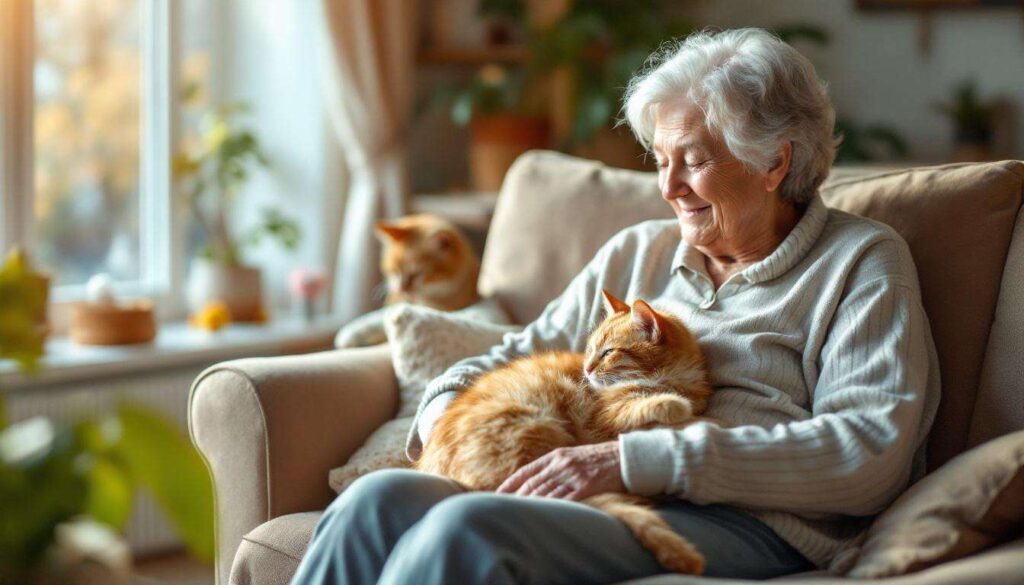
Feline companionship brings with it a fascinating phenomenon that many cat owners recognise: their pet often displays a clear preference for one particular family member. This selective attachment, far from being random, results from a complex interplay of behavioural patterns, environmental factors and individual personalities. Understanding the mechanisms behind this choice offers valuable insights into the feline mind and provides practical guidance for strengthening the human-animal bond.
How do cats choose their favourite human ?
The role of early socialisation
A cat’s preference for certain individuals begins forming during the critical socialisation period between two and seven weeks of age. Kittens exposed to gentle, consistent human interaction during this window develop more trusting relationships throughout their lives. Those who experience positive encounters with a variety of people tend to become more sociable adults, whilst limited early contact can result in wariness or selectivity in their attachments.
Communication styles and feline perception
Cats possess remarkably acute sensory abilities that inform their social choices. They evaluate potential companions through multiple channels:
- Vocal tone and volume, favouring softer, higher-pitched voices
- Body language and movement patterns, preferring calm, predictable behaviour
- Scent profiles, which convey emotional states through pheromones
- Facial expressions and eye contact patterns
The individual who communicates in ways that align with feline preferences naturally becomes more appealing. Cats typically gravitate towards those who understand indirect communication and respond appropriately to subtle signals rather than overwhelming them with attention.
The influence of routine and predictability
Felines thrive on consistency, and the person who maintains regular schedules for feeding, play and rest often earns special status. This predictability creates a sense of security that forms the foundation of trust. The family member who reliably appears at specific times, offering anticipated interactions, becomes associated with stability and comfort in the cat’s mental landscape.
Beyond mere routine, the quality of these interactions matters considerably, setting the stage for understanding what specific characteristics cats value most in their chosen companions.
The criteria cats use to choose a person
Respect for personal boundaries
Perhaps the most significant factor in feline preference is respect for autonomy. Cats instinctively favour individuals who allow them to initiate contact rather than imposing unwanted attention. The person who waits patiently for the cat to approach, who recognises signs of overstimulation and who permits the animal to retreat when desired demonstrates understanding that cats find irresistible.
| Behaviour Type | Cat Response | Preference Impact |
|---|---|---|
| Forcing interaction | Avoidance, stress | Negative |
| Allowing cat-initiated contact | Relaxation, approach | Strongly positive |
| Ignoring the cat | Curiosity, gradual approach | Moderately positive |
| Reading body language | Trust, extended interaction | Very positive |
Meeting physical and emotional needs
The individual who consistently provides for a cat’s requirements naturally rises in the animal’s estimation. This extends beyond basic sustenance to encompass:
- Regular feeding at preferred times with appropriate food
- Engaging play sessions that satisfy hunting instincts
- Grooming assistance, particularly for long-haired breeds
- Comfortable resting spaces in favoured locations
- Environmental enrichment through toys and climbing opportunities
Emotional availability proves equally important. Cats often select the person who remains calm during stressful situations, offering reassurance without excessive fuss. This emotional stability creates a safe haven that cats actively seek.
Energy levels and temperament matching
Feline personalities vary considerably, and cats frequently choose humans whose energy levels complement their own. An active, playful cat may bond most strongly with an energetic family member who engages in frequent interactive play, whilst a more reserved feline might prefer someone quieter who provides peaceful companionship. This natural matching process ensures compatibility and mutual satisfaction in the relationship.
These selection criteria manifest in observable behaviours that reveal which family member holds the coveted position of favourite.
Signs that you are your cat’s favourite human
Physical displays of affection
Cats demonstrate preference through distinctive tactile behaviours reserved for their chosen person. Head bunting, where the cat presses its forehead against you, represents one of the most significant gestures, as facial glands deposit pheromones that mark you as part of their social group. Similarly, cheek rubbing serves both as scent marking and an expression of affection.
The slow blink, often called a “cat kiss”, indicates deep trust and contentment. When your cat makes eye contact and deliberately closes its eyes slowly, reciprocating this gesture strengthens your bond. Kneading behaviour, accompanied by purring, recalls kittenhood nursing and signals profound comfort in your presence.
Following and proximity seeking
A cat that consistently follows you from room to room, settles nearby during your activities or chooses to sleep on your bed demonstrates clear preference. This proximity-seeking behaviour indicates that your presence provides security and satisfaction. Cats may also:
- Wait outside bathroom doors
- Greet you enthusiastically upon your return home
- Position themselves to maintain visual contact
- Interrupt your activities to solicit attention
Vocal communication patterns
Cats develop unique vocalisations for their favourite people, often employing specific chirps, trills or meows reserved exclusively for that individual. Increased vocalisation in your presence, particularly the distinctive “greeting trill”, suggests you hold special status. The cat may also respond more readily to your voice compared to other family members.
Vulnerable behaviour displays
Perhaps the most telling sign involves vulnerability displays. A cat that exposes its belly, sleeps in your lap or presents its back to you demonstrates exceptional trust, as these positions leave it defenceless. Bringing you “gifts”, whether toys or prey, represents sharing hunting success with a valued companion. Grooming attempts, though sometimes uncomfortable, indicate the cat views you as family deserving of care.
Understanding why cats develop these strong preferences provides context for these behaviours and insights into feline social structures.
Why do cats have favourite people ?
Evolutionary and survival perspectives
From an evolutionary standpoint, selective bonding served survival purposes for cats’ wild ancestors. Forming strong attachments to reliable providers of resources whilst maintaining wariness towards others represented an adaptive strategy. Domestic cats retain this tendency, identifying individuals who consistently meet their needs as worthy of trust and affection.
This selectivity also reflects the semi-social nature of felines. Unlike pack animals that bond indiscriminately with group members, cats form individual relationships based on personal assessment. This discriminating approach ensures they invest energy in connections that offer genuine benefits.
Individual personality and past experiences
Each cat possesses a distinct personality shaped by genetics and experience. Previous encounters with humans, particularly during formative periods, influence future preferences. A cat rescued from difficult circumstances may favour the person who provided initial care, whilst one raised in a stable environment might select based purely on current interactions.
| Cat Personality Type | Likely Preference | Reason |
|---|---|---|
| Confident and outgoing | Active, engaging person | Matches energy for play |
| Shy and reserved | Calm, patient individual | Provides security without pressure |
| Attention-seeking | Responsive, interactive person | Satisfies social needs |
| Independent | Respectful of space | Allows autonomy |
Resource control and security
Practical considerations influence preference formation. The person who controls valued resources, particularly food, litter maintenance and access to favourite spaces, naturally becomes important in the cat’s life. However, this extends beyond mere provision to encompass the manner of delivery. Someone who feeds regularly but handles the cat roughly may provide sustenance without earning affection, whilst another who offers treats respectfully gains favour.
These underlying reasons suggest specific approaches for those wishing to enhance their relationship with feline companions.
Strengthening the bond with your cat
Interactive play and mental stimulation
Regular, engaging play sessions represent one of the most effective bonding tools. Using interactive toys that mimic prey movements satisfies hunting instincts whilst creating positive associations with your presence. Aim for multiple short sessions daily rather than occasional lengthy ones, and always allow the cat to “catch” the prey periodically to prevent frustration.
Mental stimulation through puzzle feeders, training exercises and environmental enrichment demonstrates investment in the cat’s wellbeing. Teaching simple commands or tricks using positive reinforcement builds communication and mutual understanding whilst providing cognitive challenges cats find rewarding.
Consistent, positive interactions
Quality matters more than quantity in feline relationships. Brief, pleasant encounters throughout the day prove more valuable than forced extended contact. Consider these approaches:
- Offer treats during calm moments to reinforce peaceful coexistence
- Provide gentle grooming sessions if your cat enjoys them
- Speak softly and use the cat’s name positively
- Respect signs of overstimulation and end interactions appropriately
- Create rituals around feeding times or bedtime
Understanding and responding to communication
Developing fluency in feline body language transforms the relationship. Learning to recognise subtle signals, from ear positions to tail movements, allows appropriate responses that build trust. When your cat displays contentment through relaxed posture and slow blinks, acknowledge this communication. Similarly, recognising stress indicators like flattened ears or a lashing tail prevents negative interactions.
Responding appropriately to vocalisations strengthens communication channels. If your cat trills in greeting, acknowledge this with a gentle verbal response. When it meows for attention, assess whether the request is reasonable before responding, teaching appropriate communication patterns.
For cats that remain hesitant despite these efforts, additional strategies may prove necessary to establish fundamental trust.
Helping your cat to trust you more easily
Creating a secure environment
Trust develops most readily in environments where cats feel physically and emotionally safe. Ensure your home provides vertical spaces for observation and retreat, hiding spots for security and consistent routines that reduce anxiety. Minimise loud noises, sudden movements and household chaos that can undermine a cat’s sense of safety.
For nervous or newly adopted cats, establish a dedicated safe room containing all necessities. Allow the cat to acclimate at its own pace, gradually expanding access to other areas as confidence grows. This controlled introduction prevents overwhelming the animal whilst demonstrating that you respect its comfort levels.
Patience and non-demanding presence
Building trust requires time, particularly with cats that have experienced trauma or limited socialisation. Resist the urge to force interaction, instead making yourself available without expectations. Sitting quietly in the same room whilst reading or working allows the cat to observe and approach when ready.
The technique of “being boring” proves remarkably effective: ignore the cat whilst remaining present, allowing curiosity to overcome wariness. Many cats find non-demanding humans irresistible, eventually approaching to investigate this unusual behaviour.
Positive association techniques
Systematically pairing your presence with positive experiences accelerates trust development. Each time you enter the room, toss a treat in the cat’s direction without approaching. Gradually decrease the distance over days or weeks, always allowing the cat to maintain comfortable spacing. This classical conditioning creates positive associations with your appearance.
Similarly, engage in enjoyable activities near the cat without direct interaction. Playing with toys nearby, offering catnip or opening a window for viewing entertainment whilst you sit calmly nearby demonstrates that your presence brings benefits without threats.
Feline preferences, whilst sometimes frustrating for overlooked family members, reflect sophisticated social assessment and individual personality. The cat that chooses a favourite demonstrates not caprice but rather discernment, selecting the person whose behaviour, energy and interactions best align with feline needs and communication styles. Understanding the criteria cats employ, recognising signs of preference and implementing strategies to strengthen bonds enables all family members to develop rewarding relationships with their feline companions. Through patience, respect for boundaries and consistent positive interactions, anyone can become worthy of a cat’s selective affection, transforming coexistence into genuine companionship built on mutual trust and understanding.