



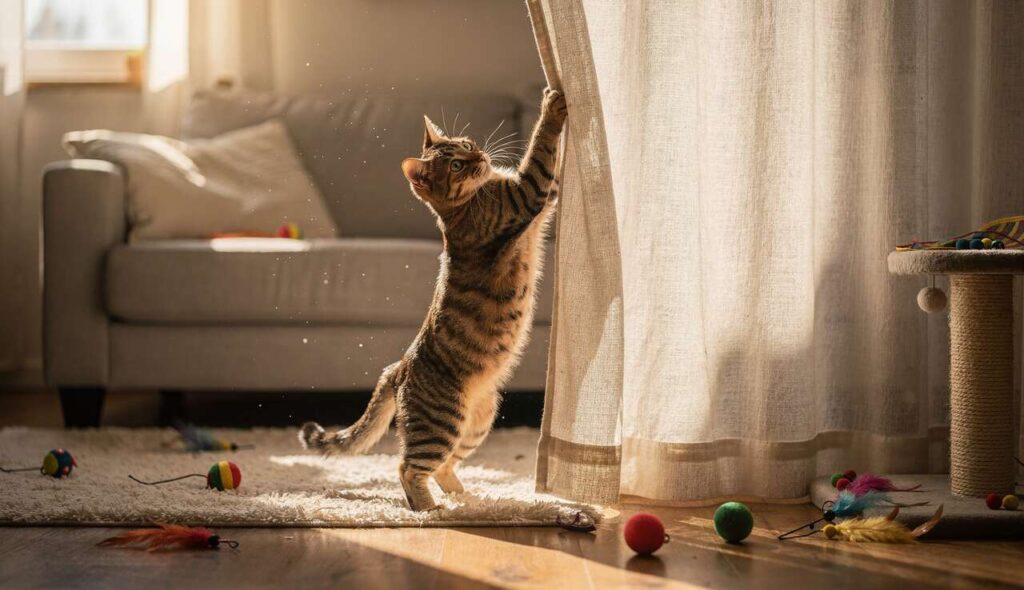
Cat owners across the country share a common frustration: despite investing in an array of expensive toys, scratching posts, and climbing structures, their feline companions consistently choose to scale the living room curtains instead. This perplexing behaviour leaves many wondering whether their cats are simply being difficult or if there’s a deeper explanation rooted in their natural instincts. The truth is that curtain climbing represents far more than mere mischief; it’s a window into understanding the complex needs and evolutionary drives that shape feline behaviour in domestic settings.
Understanding the natural behaviour of cats
Evolutionary instincts that drive climbing behaviour
Cats are descended from wild ancestors who relied on climbing for survival. Their evolutionary history has hardwired specific behaviours that persist even in domesticated environments. Felis silvestris lybica, the African wildcat from which domestic cats evolved, regularly climbed trees to escape predators, hunt birds, and survey their territory from elevated positions.
The physical adaptations that enable climbing remain intact in modern house cats:
- Retractable claws designed to grip vertical surfaces
- Powerful hind leg muscles that propel upward leaps
- Exceptional balance maintained by a flexible spine and tail
- Sharp vision that allows assessment of climbing routes
The hunting instinct and vertical movement
Climbing serves multiple purposes in the feline behavioural repertoire. Vertical movement activates hunting instincts because prey animals often flee upwards or inhabit elevated spaces. When your cat scales the curtains, they’re engaging the same neural pathways that would activate during a hunt in the wild. The texture of fabric provides sensory feedback similar to tree bark, whilst the swaying motion mimics the movement of branches, creating an irresistible stimulus for cats programmed to pursue moving targets.
These deeply ingrained instincts explain why even well-fed, indoor cats continue to display climbing behaviours that seem unnecessary in a domestic context. Understanding this foundation helps explain why curtains hold such particular appeal.
The allure of heights: a question of safety
Elevated positions as survival strategy
For cats, height equals safety. This equation is fundamental to feline psychology and influences virtually every aspect of their spatial behaviour. From an elevated vantage point, cats can monitor their environment for potential threats whilst remaining out of reach of ground-based predators. This survival strategy is so deeply embedded that domestic cats retain it despite the absence of natural predators in most homes.
| Height level | Cat’s perception | Behavioural response |
|---|---|---|
| Floor level | Vulnerable, exposed | Alert, ready to flee |
| Mid-height (1-1.5m) | Moderately secure | Relaxed but watchful |
| High perches (2m+) | Safe, in control | Calm, confident |
Stress reduction through elevation
Curtains offer an immediate route to psychological comfort. When cats feel stressed, anxious, or overstimulated, their instinct drives them upward. The act of climbing itself releases tension, whilst the elevated position provides a sense of control over their environment. In multi-pet households or busy family homes, curtains become an accessible escape route when floor-level toys and activities feel overwhelming.
This relationship between height and emotional wellbeing reveals why addressing curtain climbing requires more than simply providing alternative entertainment.
The role of territory in feline behaviour
Vertical territory versus horizontal space
Cats perceive their environment in three dimensions, not just the horizontal plane that humans typically consider. Whilst we measure living space in square metres, cats evaluate their territory in cubic metres. Vertical space is just as important as floor area, and often more valuable because it offers the safety advantages discussed previously.
When cats climb curtains, they’re not ignoring their toys; they’re expanding their territorial claim into underutilised vertical space. Floor-based toys, no matter how numerous or expensive, only address horizontal territory and therefore fail to satisfy a fundamental territorial need.
Scent marking and territorial ownership
Climbing behaviour also serves a territorial function through scent marking. Cats possess scent glands in their paws, and the act of climbing deposits their unique scent signature on surfaces. Your curtains become scent-marked territorial boundaries that communicate ownership. This explains why cats often return repeatedly to the same curtains, reinforcing their claim through both visual and olfactory markers.
The territorial dimension of curtain climbing connects directly to why conventional toys often prove inadequate substitutes.
Why toys are not enough
The limitations of floor-based entertainment
Most cat toys are designed with human convenience in mind rather than feline psychology. They typically remain at ground level, require human interaction to be interesting, or fail to engage multiple senses simultaneously. Static toys particularly struggle to compete with the dynamic, multi-sensory experience that curtain climbing provides.
Consider what curtain climbing offers compared to typical toys:
- Physical challenge engaging multiple muscle groups
- Sensory feedback from fabric texture and movement
- Achievement of an elevated, secure position
- Territorial claiming through scent marking
- Environmental observation from a strategic vantage point
- Stress relief through physical activity and elevation
The need for environmental complexity
Cats require environmental enrichment that mirrors the complexity of their natural habitat. A basket of toys, regardless of quantity, cannot replicate the three-dimensional, multi-sensory environment that wild cats navigate. Curtains inadvertently provide this complexity: they’re vertical, they move, they offer texture, they lead somewhere, and they result in a reward (height and security).
Recognising these limitations points toward the need for more comprehensive environmental modifications rather than simply purchasing more toys.
Adapting your home for harmonious cohabitation
Creating vertical pathways and territories
Successful cohabitation requires intentional design of vertical spaces that satisfy your cat’s instinctual needs. This means installing purpose-built structures that provide the same benefits as curtain climbing without the destruction. Cat trees, wall-mounted shelves, and climbing systems should be positioned strategically throughout your home, particularly near windows where cats can observe outdoor activity.
Effective vertical territories include:
- Multi-level cat trees reaching near ceiling height
- Wall-mounted shelves creating aerial pathways
- Window perches at various heights
- Secure, elevated hiding spots
- Climbing poles or ladders integrated into room design
Balancing human aesthetics with feline needs
Many owners resist installing obvious cat furniture due to aesthetic concerns, but modern solutions increasingly blend functionality with design. Minimalist wall shelves, stylish cat trees, and integrated climbing structures can complement contemporary interiors whilst meeting feline requirements. The investment in attractive, functional vertical spaces typically proves more cost-effective than repeatedly replacing damaged curtains.
| Solution type | Installation complexity | Space efficiency | Aesthetic integration |
|---|---|---|---|
| Free-standing cat tree | None (portable) | Moderate | Variable |
| Wall-mounted shelves | Moderate | Excellent | High |
| Integrated climbing walls | High | Excellent | Very high |
These environmental adaptations form the foundation for addressing curtain climbing, but specific strategies can further protect your soft furnishings.
How to meet your cat’s needs without sacrificing your curtains
Strategic placement of climbing alternatives
The location of alternative climbing structures proves as important as their existence. Position cat trees and climbing posts directly beside windows where curtains typically hang. This placement intercepts the cat’s route to the curtains whilst offering the same window access and elevated viewing position. Cats naturally choose the most stable, purpose-built structure when it’s conveniently located.
Making curtains less appealing
Whilst providing alternatives, you can simultaneously reduce curtain appeal through gentle deterrents. Double-sided tape applied to the lower portions of curtains creates an unpleasant texture that discourages climbing without harming your cat. Alternatively, temporarily replacing heavy drapes with blinds or lightweight curtains removes the structural support needed for climbing.
Positive reinforcement and redirection
When you observe your cat approaching curtains, immediately redirect them to appropriate climbing structures using treats, toys, or catnip as motivation. Reward successful use of cat trees and wall shelves with praise and treats. This positive reinforcement gradually reshapes behaviour by creating stronger associations between climbing alternatives and rewarding outcomes.
Environmental enrichment beyond climbing
Comprehensive enrichment reduces the intensity of any single behaviour, including curtain climbing. Incorporate these elements:
- Interactive feeding puzzles that engage hunting instincts
- Regular play sessions with wand toys simulating prey movement
- Rotating toy selection to maintain novelty
- Access to safe outdoor enclosures or supervised garden time
- Multiple resting spots at various heights throughout the home
When cats receive adequate physical exercise, mental stimulation, and territorial security through purpose-built structures, curtain climbing typically diminishes significantly. The behaviour rarely disappears entirely, as it remains part of the feline behavioural repertoire, but its frequency and intensity reduce to manageable levels. Success requires patience and consistency, as cats need time to establish new habits and preferences. By understanding the evolutionary and psychological drivers behind curtain climbing, owners can create living spaces that satisfy both human aesthetic preferences and feline instinctual needs, resulting in happier cats and intact soft furnishings.