



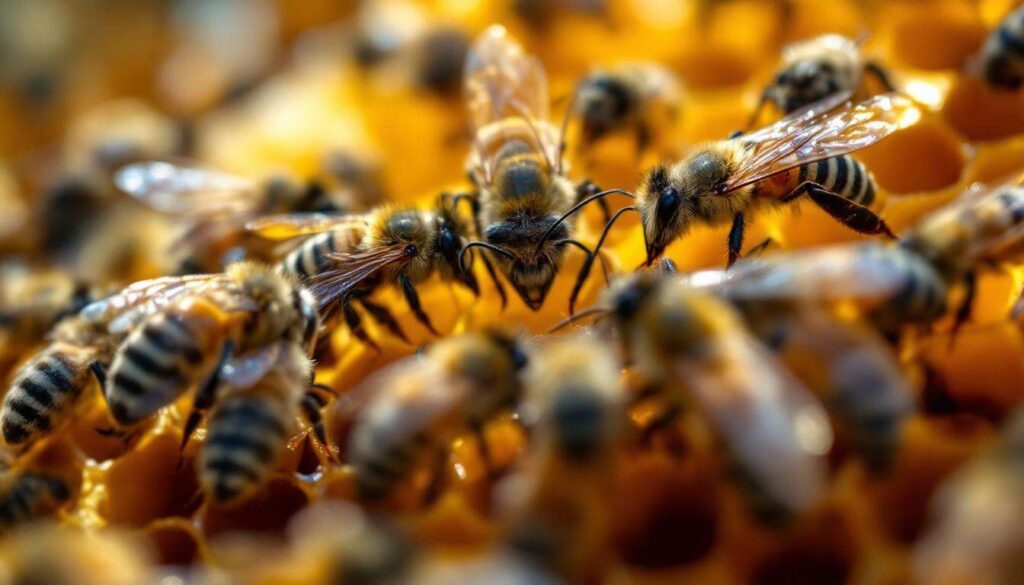
Honey bee colonies operate under a delicate social structure where the queen reigns supreme, yet recent scientific findings reveal that worker bees possess remarkable abilities to detect when their monarch falls ill. Research demonstrates that these industrious insects can identify viral infections compromising their queen’s health and fertility, triggering coordinated responses that may culminate in her removal from power. This discovery offers crucial insights into colony dynamics and survival mechanisms, particularly as global bee populations face unprecedented challenges.
The life of a queen
Monarchical responsibilities within the hive
The queen bee occupies a singular position within the colony, serving as the sole reproductive female capable of laying fertilised eggs. Her primary function involves producing thousands of eggs daily during peak season, ensuring the colony maintains sufficient population levels to thrive. Unlike her sterile worker bee daughters, she possesses fully developed ovaries and can live for several years, far exceeding the lifespan of ordinary colony members.
Chemical communication and colony cohesion
Beyond egg production, the queen maintains social order through sophisticated chemical signalling. She secretes a complex blend of pheromones that serve multiple purposes:
- Suppressing reproductive capabilities in worker bees
- Attracting drones during mating flights
- Signalling her presence and health status throughout the hive
- Coordinating colony activities and behaviour
These pheromonal signatures act as constant broadcasts of her vitality, informing workers that their colony possesses a healthy and productive leader. The chemical messages circulate through physical contact as workers groom the queen and distribute her pheromones throughout the hive via trophallaxis, the mouth-to-mouth transfer of food and chemical signals.
However, this sophisticated system becomes vulnerable when disease strikes, setting the stage for dramatic shifts in colony dynamics.
Queen autopsies: unveiling the viral infection
Pathological discoveries in royal specimens
Scientific examination of deposed queens has revealed critical evidence of viral infections affecting their reproductive systems. Researchers conducting post-mortem analyses discovered that many overthrown queens harboured significant viral loads, particularly in their ovarian tissues. These infections directly compromised their egg-laying capacity, the fundamental measure of a queen’s value to her colony.
| Infection type | Impact on queen | Detection method |
|---|---|---|
| Ovarian viruses | Reduced egg production | Tissue analysis |
| Deformed wing virus | General health decline | Molecular screening |
| Black queen cell virus | Developmental abnormalities | Laboratory testing |
The fertility-infection connection
The research conducted at the University of British Columbia established a direct correlation between viral presence and diminished reproductive output. When viruses infiltrate the queen’s ovaries, they disrupt normal cellular function, leading to fewer viable eggs and reduced brood quality. This decline represents a catastrophic threat to colony survival, as insufficient egg production cannot replace the natural mortality rate of worker bees.
Understanding these pathological mechanisms provides essential context for interpreting worker bee responses to their ailing monarch.
The workers’ dilemma
Detecting decline through chemical signals
Worker bees face a critical decision when their queen’s health deteriorates. Their survival instinct demands accurate assessment of the queen’s condition, as premature replacement wastes resources whilst delayed action risks colony collapse. Fortunately, workers possess sophisticated sensory capabilities that enable them to monitor royal health through pheromonal analysis.
The supersedure decision-making process
When workers detect abnormal pheromone profiles, they initiate a process called supersedure, a controlled replacement of the failing queen. This response involves several coordinated stages:
- Recognition of altered chemical signatures indicating poor health
- Construction of special queen cells for raising replacement candidates
- Selection of young larvae to receive royal jelly feeding
- Protection of developing virgin queens until emergence
- Elimination of the old queen once successors mature
This democratic process demonstrates remarkable collective intelligence, as thousands of workers reach consensus without centralised leadership. The decision balances immediate colony needs against the risks inherent in leadership transitions, showcasing evolutionary adaptation to disease pressures.
The biochemical mechanisms underlying this detection capability reveal even more fascinating details about bee communication.
Weakened pheromones: viral shock and chemistry
Methyl oleate as a health indicator
Among the queen’s pheromonal repertoire, methyl oleate emerges as a particularly significant compound. This chemical serves as a reliable indicator of the queen’s health and productivity, with concentrations correlating directly to her egg-laying capacity. Healthy queens produce abundant methyl oleate, whilst infected individuals show markedly reduced levels.
Viral impact on chemical production
Research demonstrates that viral infections specifically target the biological pathways responsible for pheromone synthesis. When viruses compromise ovarian function, the queen’s ability to manufacture and secrete methyl oleate diminishes proportionally. This creates a biochemical alarm system that workers can readily detect through their highly sensitive antennae.
| Queen condition | Methyl oleate level | Worker response |
|---|---|---|
| Healthy and productive | High concentration | Normal colony function |
| Mild infection | Moderate reduction | Increased monitoring |
| Severe infection | Significant depletion | Supersedure initiation |
This chemical diagnostic system operates continuously, providing real-time updates on royal health status and enabling rapid response to deteriorating conditions.
Revolt and expulsion: the end of a queen
Coordinated removal procedures
Once workers reach consensus regarding their queen’s inadequacy, they implement systematic removal protocols. The process typically unfolds with remarkable efficiency, as workers cease attending to the failing queen, withdrawing the grooming and feeding services essential to her survival. Some colonies exhibit more aggressive behaviour, with workers actively harassing the deposed monarch until she perishes or abandons the hive.
Consequences for colony stability
Queen replacement events create temporary vulnerabilities within the colony structure. The implications include:
- Gaps in egg production lasting several weeks
- Reduced workforce numbers as older workers die without replacement
- Diminished honey production during the transition period
- Decreased pollination capacity affecting agricultural operations
- Increased susceptibility to predators and competing colonies
For beekeepers, these disruptions translate into economic losses and management challenges, particularly when multiple colonies undergo simultaneous queen failures during critical production periods.
However, emerging technologies may offer solutions to mitigate these natural but problematic events.
Synthetic solutions for a united colony
Artificial pheromone applications
Scientists have developed synthetic methyl oleate formulations that can supplement or replace natural queen pheromones. These artificial compounds offer beekeepers tools to stabilise colonies experiencing queen health issues, potentially preventing premature supersedure events. By maintaining adequate pheromone levels, synthetic applications may extend the productive lifespan of moderately compromised queens whilst replacement candidates develop.
Disease-resistant breeding programmes
Long-term solutions focus on developing queen lineages with enhanced viral resistance. Selective breeding initiatives target:
- Genetic markers associated with disease immunity
- Enhanced pheromone production capabilities
- Improved longevity and reproductive output
- Better tolerance to environmental stressors
These breeding strategies complement pheromone supplementation, creating comprehensive approaches to colony health management that address both immediate crises and underlying vulnerabilities.
Understanding worker bee detection capabilities and implementing appropriate interventions represents crucial steps towards reversing declining pollinator populations and ensuring agricultural sustainability.
The revelation that worker bees possess sophisticated disease detection abilities fundamentally alters our understanding of colony dynamics and survival strategies. These findings demonstrate that honey bee societies employ complex chemical communication systems enabling collective health monitoring and coordinated responses to royal illness. As global bee populations continue facing unprecedented pressures from pathogens, pesticides, and habitat loss, insights into natural disease management mechanisms provide valuable guidance for conservation efforts. The development of synthetic pheromones and disease-resistant breeding programmes offers practical applications of this research, potentially stabilising vulnerable colonies whilst addressing root causes of decline. Protecting these remarkable insects requires integrating scientific knowledge with sustainable beekeeping practices, ensuring pollinator services essential to ecosystem function and food security persist for future generations.